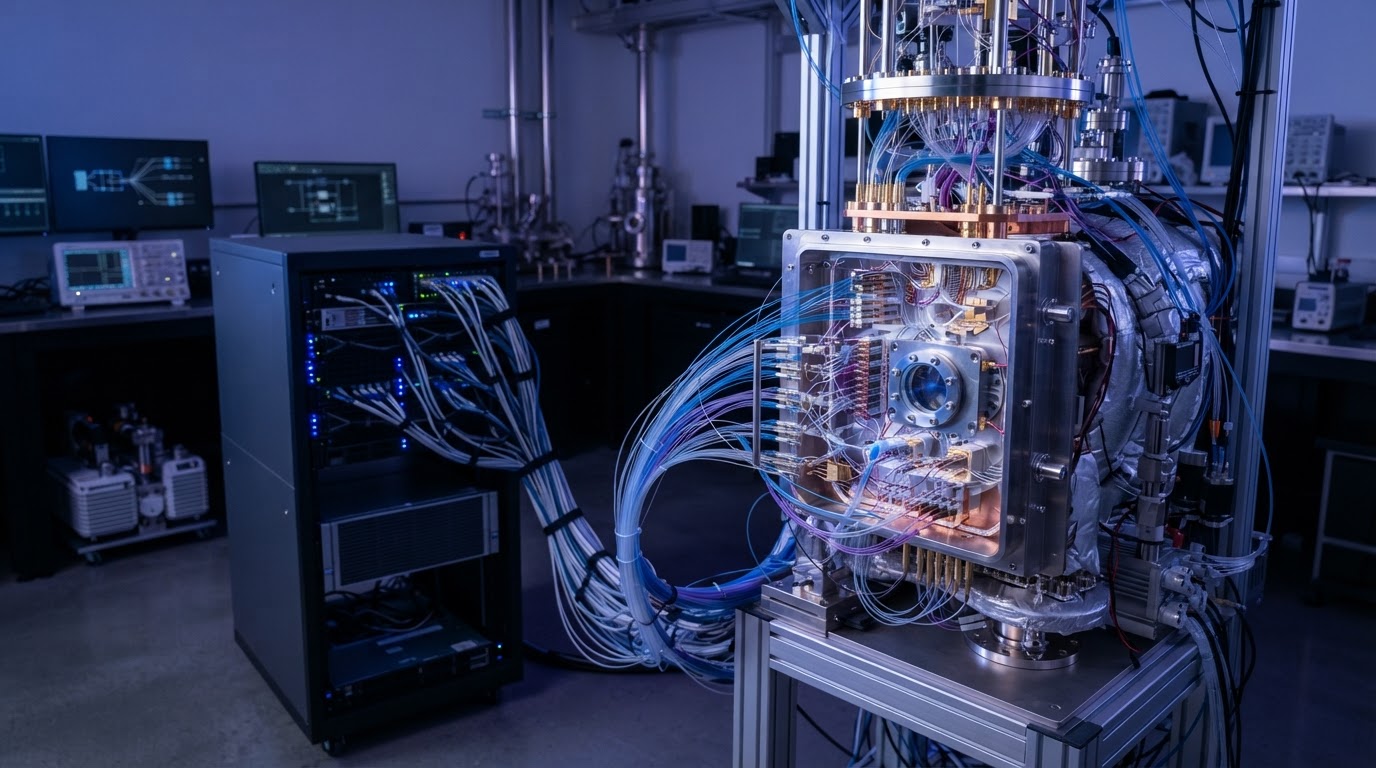
AMD and quantum-computing company PsiQuantum have expanded their partnership to develop the classical computing infrastructure needed to operate large-scale, fault-tolerant quantum computers. Announced on November 12, 2026, the agreement brings AMD’s CPUs, GPUs, programmable chips and software into a collaboration built around PsiQuantum’s photonic quantum technology. The companies outlined the plan in a joint announcement. AMD also plans to make an equity investment in PsiQuantum, although the amount was not disclosed; Reuters reported the same day that the investment forms part of the expanded partnership.
A broader partnership around the full computing stack
The companies had already been working together on AMD Versal field-programmable gate arrays, or FPGAs, which PsiQuantum selected for its quantum-computing platform. The expanded agreement adds AMD Instinct GPUs, EPYC server CPUs and the ROCm software stack. The goal is to co-design systems that combine conventional high-performance computing, AI workloads and photonic quantum processors rather than treating a quantum machine as a standalone device.
That combination reflects a practical requirement of fault-tolerant quantum computing. Quantum processors are sensitive to errors, and useful systems need extensive classical processing for control, decoding, simulation and error correction. PsiQuantum says the collaboration is intended to combine the speed and accuracy of AMD hardware with its own workflows and photonic architecture. The announcement does not provide a delivery schedule or a performance target for a completed system.
Why PsiQuantum is betting on photons
Unlike approaches based on matter such as trapped ions or superconducting circuits, PsiQuantum uses photons to carry quantum information. Its architecture relies on silicon photonics and a modular design intended to connect many smaller components into a larger machine. The company says this approach can use established semiconductor manufacturing and standard optical fibre to link parts of a system.
In its explanation of its quantum architecture, PsiQuantum describes error correction as essential because quantum hardware is inherently noisy. The company’s approach uses entangled photonic resource states and fusion operations to build a fault-tolerant computational fabric. These are demanding engineering goals, and the partnership announcement should not be read as evidence that a commercially useful, utility-scale quantum computer is already operating.
Drug discovery is an early area of focus
The partners identified pharmaceutical research and drug discovery as an initial application area. PsiQuantum says its computational chemistry workflows have already been run on AMD hardware, including large-scale GPU simulations of covalent inhibitors, a class of molecules relevant to oncology research. The companies describe those results as an early starting point for exploring integrated accelerated-computing solutions.
That work is still a research direction, not a claim that the partnership has produced a new medicine or replaced established drug-development methods. More broadly, the companies point to potential applications in healthcare, materials, energy and finance, where future fault-tolerant quantum systems could be combined with conventional supercomputers and AI tools.
The partnership fits a wider push toward quantum systems
The announcement arrives as governments and research organisations are trying to define what a useful quantum computer should be able to do. The U.S. Department of Energy’s Quantum Genesis initiative is intended to advance scientifically relevant, fault-tolerant systems and connect quantum computing with high-performance computing and AI. The department has identified applications in chemistry, materials science, physics and applied mathematics.
PsiQuantum has also been developing sites in Chicago and Queensland as part of its plan to move beyond laboratory-scale systems. The company says its silicon-photonic chips are manufactured using semiconductor processes, while its modular design is intended to scale through optical connections. AMD’s contribution would give the project access to a broad classical-computing platform, but the difficult work of building, integrating and validating a fault-tolerant quantum system remains.
In the joint announcement, the companies said they would share more about their strategic partnership at the SC26 conference in Chicago, scheduled for November 15–20, 2026. Further details may clarify engineering milestones and how the collaboration will be organised.
Conclusion
The expanded AMD–PsiQuantum agreement highlights how quantum computing depends on more than the quantum processor itself. Classical CPUs, GPUs, programmable hardware and software are all part of the path toward reliable machines. The planned investment and wider technical collaboration are meaningful steps, but they do not remove the scientific and engineering challenges that remain before fault-tolerant quantum computers can deliver practical results at scale.