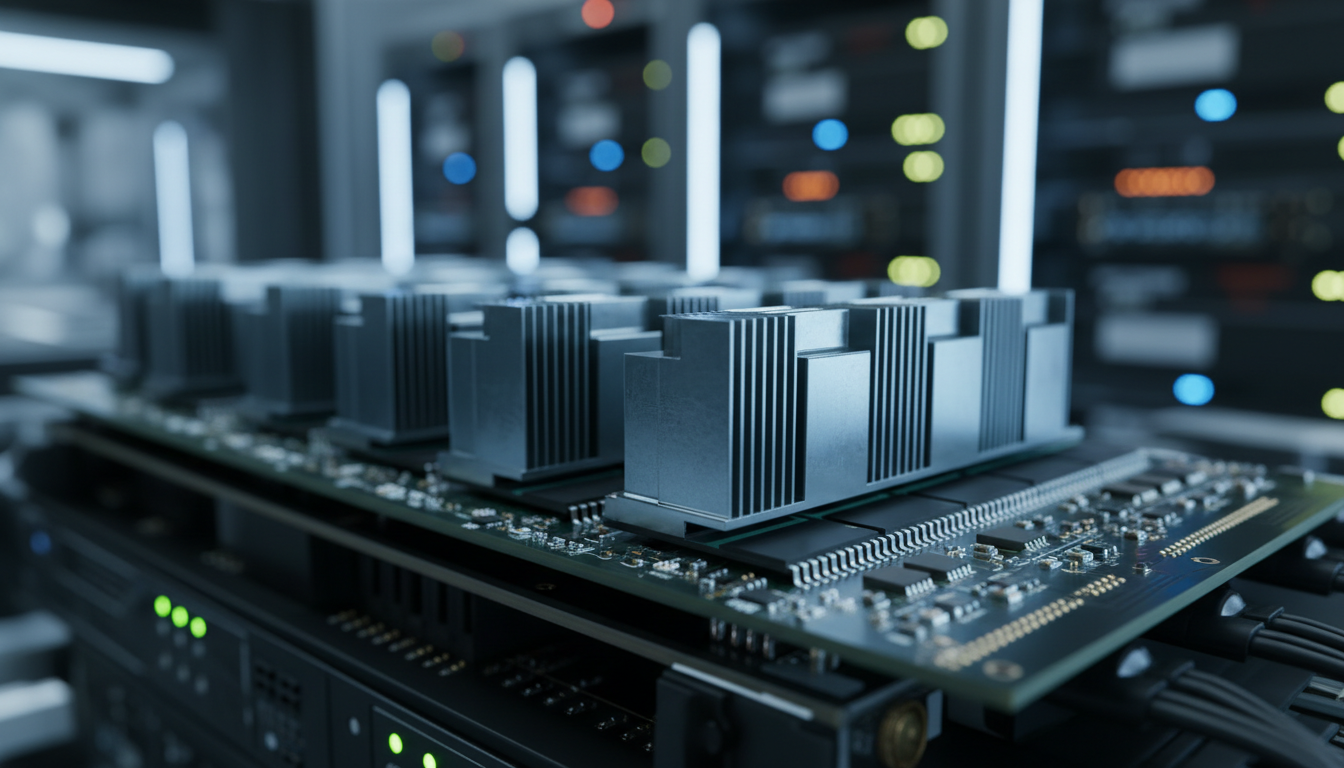
Artificial intelligence is changing the economics of the semiconductor industry, and the impact is spreading beyond the processors that attract the most attention. Memory chips are becoming a critical constraint for data centers as companies build systems capable of training and running increasingly demanding AI models.
AI systems need more than powerful processors
A graphics processor or AI accelerator can perform enormous numbers of calculations, but it needs fast access to data to keep those calculations moving. High-bandwidth memory, or HBM, is designed to deliver large amounts of data to specialized processors. Conventional DRAM is also essential for servers that coordinate workloads, store active information and support the wider data center.
As AI models grow and services handle more users, memory requirements increase. Systems that support long context windows, multiple AI agents or real-time inference can be especially demanding because they need to keep more information available while processing requests.
Why supply cannot expand overnight
Memory manufacturing requires expensive facilities, specialized equipment and long planning cycles. Semiconductor companies can invest in additional capacity, but new production does not appear immediately. The industry must also balance investment between different memory products, since capacity designed for one type of chip cannot always be switched quickly to another.
A July 2026 analysis from Deloitte said AI demand had pushed memory prices sharply higher, with AI server DRAM costs roughly doubling in the first quarter of the year. The report warned that new capacity could take several years to come online. These estimates are forecasts, not a guarantee of how prices will move in every product category.
The effects can reach ordinary PC buyers
Data center demand can influence the broader memory market because manufacturers make decisions about where to allocate investment and production. If high-value server memory absorbs more capacity, other segments may face tighter supply or higher costs. That can affect the price of desktop memory, laptops, graphics cards and other devices that depend on DRAM.
The effect is not always immediate or uniform. Consumer memory prices also depend on inventory, contracts, demand for PCs and phones, manufacturing yields and competition among suppliers. Still, a prolonged period of strong AI infrastructure spending can change the balance of the market.
Can new technology ease the pressure?
Chipmakers are working on denser memory, improved packaging and more efficient architectures. AI developers are also trying to reduce memory requirements through better model design, quantization, caching and software optimization. These improvements can make existing hardware go further, although they are unlikely to remove the need for large amounts of memory in advanced systems.
Conclusion
The AI boom is also a memory boom. Accelerators may get the headlines, but memory capacity and bandwidth increasingly determine how much useful work an AI system can perform. For consumers, the most practical takeaway is to pay attention to memory prices and device configurations when planning an upgrade, particularly while data center investment continues to reshape semiconductor demand.
Leave a Reply