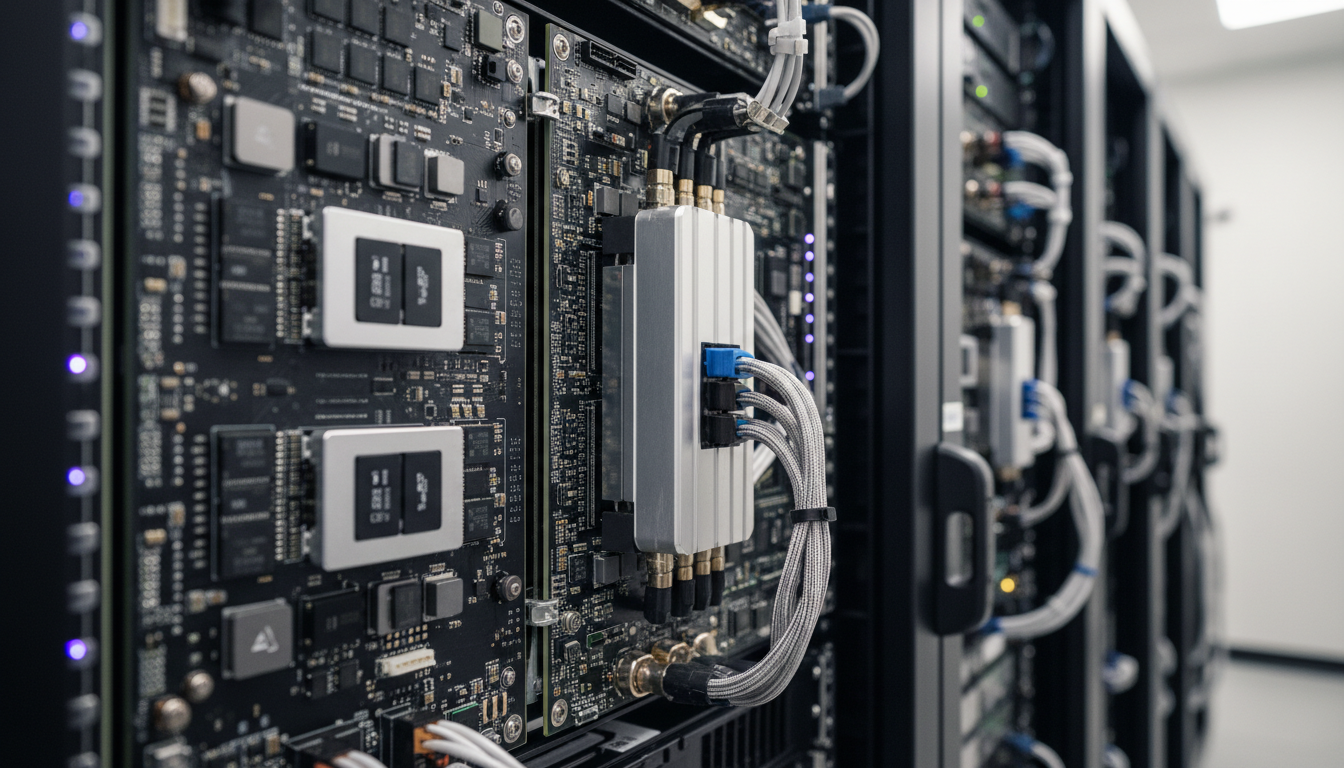
Google is expanding its custom artificial intelligence hardware lineup with two new systems designed to address challenges that are becoming increasingly important as businesses move AI agents from experiments into production. Announced on November 9, the TPU 8tx and TPU 8i Max join Google’s eighth-generation accelerator family, which already includes the TPU 8t and TPU 8i.
Two systems built for different AI workloads
The two additions are not entirely new chip designs. Google describes them as specialized systems built around its existing TPU silicon, with changes to packaging, networking, memory and security. That distinction matters because the company is trying to adapt its hardware to different customer requirements without waiting for an entirely new semiconductor generation.
TPU 8tx is aimed at organizations that need to process sensitive information while using advanced AI models. Google says the system combines TPU 8t silicon with custom AMD CPU hosts and hardware-level confidential computing. The goal is to keep data and model weights isolated even while they are actively being processed, rather than protecting information only while it is stored or moving across a network.
Google says TPU 8tx can deliver up to twice the latency performance of TPU 8t with what it describes as a near-zero performance penalty. Those figures come from Google, and real-world results will depend on the workload and deployment.
TPU 8i Max focuses on memory limits
The second system, TPU 8i Max, targets AI applications that need to work with very large amounts of context. That can include coding agents examining extensive software projects, systems processing long video sequences, or models that need to keep more information available while reasoning.
Google combines two low-latency TPU 8i chips in a single package. The company says this doubles compute, SRAM and high-bandwidth memory bandwidth compared with TPU 8i, while fitting into the same rack footprint. The idea is to reduce the time processors spend waiting for data, a growing bottleneck as AI workloads become more complex.
Google is also trying to make TPUs easier to use
Hardware is only part of the strategy. Google is also emphasizing software compatibility, including support for PyTorch and popular open-source inference tools. Lowering the effort required to move existing AI projects onto TPUs could make the platform more attractive to developers who have traditionally built around GPUs.
The announcement also highlights a broader shift in the AI infrastructure market. Performance remains important, but customers increasingly care about data protection, memory capacity, energy efficiency and the cost of running systems at scale. Specialized accelerators can help cloud providers compete for workloads that do not fit neatly into a one-size-fits-all design.
Conclusion
The TPU 8tx and TPU 8i Max show how Google is tailoring its AI infrastructure for two specific needs: confidential computing and larger workloads that can overwhelm available memory. They do not automatically displace Nvidia or guarantee lower costs for customers, but they give Google more ways to compete for enterprise AI deployments. The next important test will be availability, pricing and independent performance results.
Sources: Google Cloud’s announcement and Reuters’ industry report.
Leave a Reply