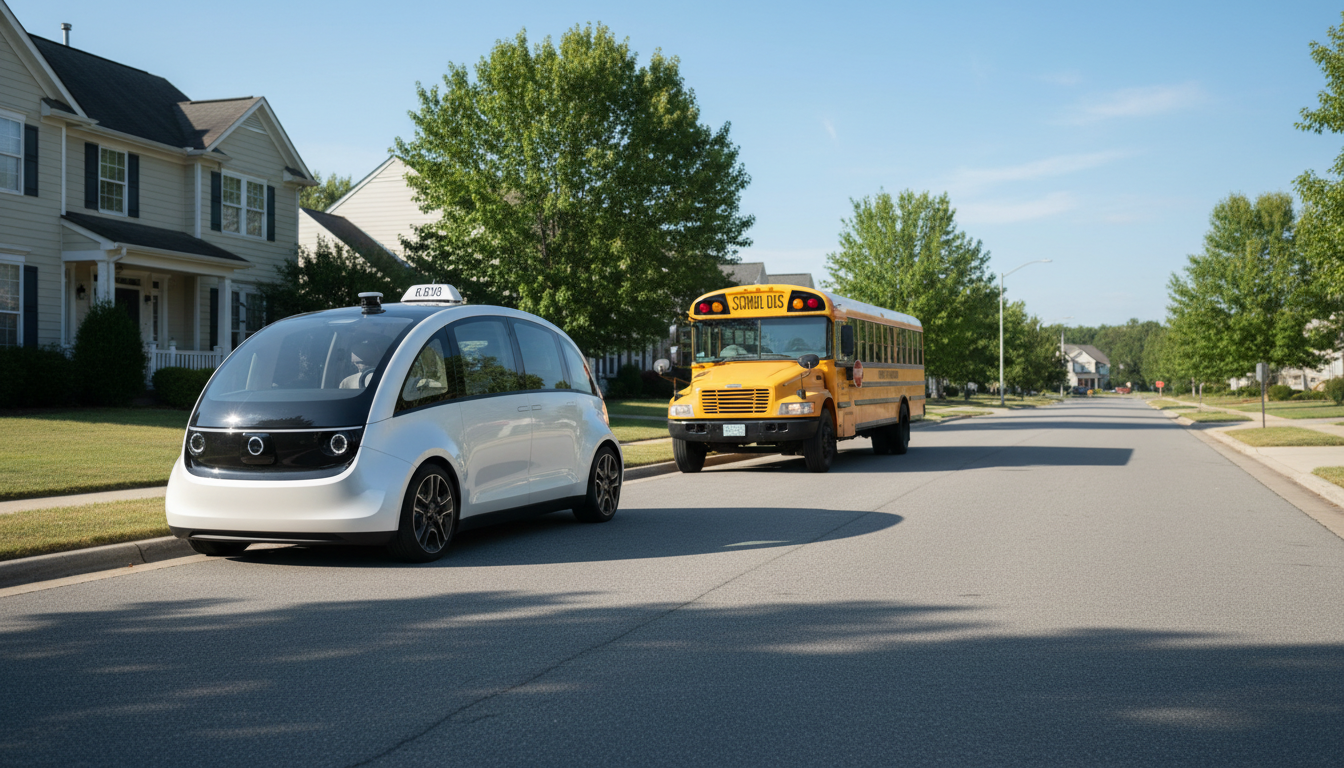
Waymo is facing renewed scrutiny from US vehicle safety regulators after reports that some of its autonomous taxis continued to pass stopped school buses, even after the company introduced a software update intended to correct the behavior. The National Highway Traffic Safety Administration has opened a recall query to assess whether the earlier remedy was adequate.
Why the school bus incidents matter
School buses use flashing red lights and extended stop arms to warn traffic that children may be boarding or leaving. Drivers are generally required to stop and wait until the bus resumes movement or the warning signals are no longer active. An autonomous vehicle must recognize and respond to those signals reliably, even in complex traffic conditions.
The issue first attracted federal attention after video showed a Waymo vehicle maneuvering around a stopped school bus in Atlanta. School officials in Austin later reported additional incidents. The latest regulatory review follows reports that a majority of the incidents examined by investigators occurred after Waymo had deployed a software update intended to address the problem.
What regulators are investigating
A recall query is a step that allows NHTSA to examine whether a manufacturer’s remedy has resolved a reported safety defect. It does not, by itself, mean regulators have reached a final conclusion or ordered a new recall. Investigators will need to assess the reported events, the vehicles’ software behavior and the effectiveness of the company’s corrective actions.
Waymo has said it completed a software update for affected vehicles in November 2025 and has indicated that it has improved how its vehicles respond to school buses. The company is expected to cooperate with the agency’s review. The central question is whether the system consistently recognizes school bus signals across different road layouts, lighting conditions and driving situations.
The challenge of autonomous driving
Autonomous vehicles must interpret a huge range of real-world situations. A stopped school bus is a particularly important test because the correct response is not simply a matter of detecting an obstacle. The vehicle must understand the meaning of flashing lights, the position of a stop arm and the possibility that children may be crossing the road.
Human drivers can also make mistakes, but autonomous systems are expected to apply rules consistently. Companies therefore need robust testing, monitoring and rapid software updates. A fix that works in one scenario may not address every variation encountered on public roads.
What happens next
The federal review could lead to further information requests, additional software changes or other regulatory action, depending on what investigators find. It also adds to the broader debate over how self-driving companies should demonstrate that their systems are safe before expanding into more cities.
Conclusion
Waymo’s latest regulatory challenge illustrates why autonomous driving safety cannot be judged only by how smoothly a vehicle handles ordinary traffic. Rare but high-consequence situations, including school bus stops, demand reliable behavior every time. The investigation will help determine whether the company’s earlier software remedy was sufficient.
Sources: TechCrunch’s report and Reuters.
Leave a Reply